Support our relaxation and educational content for free when you purchase through links on our site. Learn more
🧠 Unlock Peak Focus: The Science of Relaxation Music for Cognitive Performance (2026)

The secret to supercharging your brain isn’t a pill or a hack; it’s simply hitting play on the right relaxation music for cognitive performance to instantly lower stress and sharpen your focus. By syncing your brainwaves to specific frequencies, you can transform a chaotic afternoon into a state of deep, effortless flow.
Imagine sitting at your desk, overwhelmed by a complex project, when you slip on your headphones and hear a gentle, 60-beats-per-minute piano melody. Within minutes, your heart rate slows, the mental fog lifts, and suddenly, the solution to that problem clicks into place. This isn’t magic; it’s the proven power of sound engineering your biology.
Studies have shown that assembly workers listening to background music made 15% fewer errors and reported significantly less mental fatigue than those working in silence. Your brain craves this structured calm to operate at its highest potential.
Key Takeaways
- Instrumental is King: Always choose lyric-free music like Baroque classical or ambient soundscapes to prevent cognitive overload during language-based tasks.
- Volume Matters: Keep the sound between 50–65 dB; anything louder triggers stress responses that kill productivity.
- Target the Right Frequency: Use Alpha waves (8–12 Hz) for focused work and Theta waves (4–7 Hz) for creative brainstorming or memory consolidation.
- Timing is Crucial: Listen for 15–20 minutes before starting a task to prime your brain, then maintain the flow for 45–90 minute blocks.
- Personal Preference Counts: While structure helps, the music must make you feel calm and alert to be effective.
Table of Contents
- ⚡️ Quick Tips and Facts
- 🎼 The Science of Sound: How Relaxation Music Boosts Cognitive Performance
- 📜 From Mozart to Modern Minds: A Brief History of Music and the Brain
- 🧠 Decoding the Brainwaves: Alpha, Theta, and the Flow State
- 🎵 Top 10 Genres for Enhanced Focus and Mental Clarity
- 🎧 Curating Your Playlist: Binaural Beats vs. Ambient Soundscapes
- 🚫 The “Mozart Effect” Myth vs. Reality: What Actually Works?
- 🎹 Instrumental vs. Lyrical: Why Words Might Be Killing Your Productivity
- 📊 Case Studies: Real-World Results on Music and Memory Retention
- 🛠️ Tools of the Trade: Best Apps and Platforms for Cognitive Music
- 🎚️ Volume, Tempo, and Timing: The Golden Rules of Listening
- 🌿 Nature Sounds and White Noise: The Ultimate Cognitive Allies?
- 🧘 ♀️ Combining Music with Mindfulness for Peak Mental Performance
- 🤔 Troubleshooting: When Music Becomes a Distraction
- 🏆 Conclusion
- 🔗 Recommended Links
- ❓ FAQ
- 📚 Reference Links
⚡️ Quick Tips and Facts
Before we dive into the symphony of science, let’s hit the fast-forward button on the most critical takeaways. If you’re in a rush to boost your brainpower, here is your cheat sheet:
- Volume is King: Keep your background music between 50–65 dB. Anything louder acts as a stressor, not a stimulant. 🎚️
- Lyrics are the Enemy: When doing language-based tasks, instrumental music is non-negotiable. Your brain hates trying to process two streams of words at once. 🚫🗣️
- The “Mozart” Nuance: It’s not just about Mozart; it’s about complexity and structure. Simple loops work for some, but structured classical often wins for memory retention. 🎻
- Timing Matters: Listening for 15–30 minutes before a deep work session can prime your brain, but playing it during complex problem-solving requires caution. ⏱️
- Physiological Proof: Studies show music can lower heart rate and increase blood oxygen saturation, directly combating the fatigue that kills productivity. ❤️🩸
For a deeper dive into how these elements specifically impact your daily life, check out our guide on relaxation music benefits.
🎼 The Science of Sound: How Relaxation Music Boosts Cognitive Performance
Have you ever noticed that when you put on a specific playlist, the world just… slows down? Or maybe the opposite happens, and you suddenly feel like you can solve a Rubik’s cube in your head? That’s not magic; it’s neurochemistry.
At Endless Relaxation™, we’ve spent years curating soundscapes, but we also geek out on the why. When you listen to relaxation music, you aren’t just “hearing” sounds; you are engaging in a complex dialogue with your nervous system.
The Dopamine and Cortisol Dance
When you hear music you enjoy, your brain releases dopamine, the neurotransmitter associated with pleasure and reward. This isn’t just about feeling good; dopamine sharpens your focus and motivation. Conversely, relaxing music helps suppress cortisol, the stress hormone that clouds your judgment and shrinks your working memory.
“Background music enhanced working memory… likely due to increased relaxation.” — PLOS ONE Study on Assembly Workers
But here is the catch: not all relaxation is created equal. If the music is too sad, it might induce lethargy. If it’s too upbeat, it might induce anxiety. The sweet spot is moderate arousal, where the music keeps you alert but calm.
The Entrainment Effect
One of the most fascinating phenomena we observe is brainwave entrainment. Your brainwaves naturally sync up with the rhythm of external stimuli.
- Beta Waves (13–30 Hz): Active thinking, problem-solving.
- Alpha Waves (8–12 Hz): Relaxed focus, the “flow state.”
- Theta Waves (4–7 Hz): Deep meditation, creativity, memory consolidation.
By listening to music with a tempo that mimics these frequencies (often 60–70 BPM for Alpha), you can literally guide your brain into a state of optimal cognitive performance.
🔗 Want to explore more about the science? Read our article on Health Benefits of Relaxation Music.
📜 From Mozart to Modern Minds: A Brief History of Music and the Brain

You’ve heard of the “Mozart Effect,” right? The idea that listening to Mozart makes you smarter? Well, grab your popcorn, because the history of this concept is a bit more dramatic than a simple “listen to classical, get an A.”
The 193 Spark
It all started with a study by Rauscher, Shaw, and Ky in 193. They found that college students who listened to 10 minutes of Mozart’s Sonata for Two Pianos in D Major scored higher on spatial-temporal reasoning tests than those who sat in silence or listened to a relaxation tape.
The Media Frenzy: The press went wild. Suddenly, parents were playing Mozart for their fetuses, and schools were installing speakers in classrooms. The “Mozart Effect” became a household term.
The Reality Check
Fast forward a few years, and researchers realized the effect was temporary (lasting about 10-15 minutes) and specific to spatial tasks, not general intelligence. Furthermore, later studies showed that any music you enjoy could produce a similar effect, provided it put you in a positive, aroused state.
The Industrial Revolution of Sound
Interestingly, the use of music for performance isn’t new. During the Industrial Revolution, factories began playing music to mask the deafening noise of machinery and keep workers in rhythm. Today, we see this in the study we analyzed from PLOS ONE, where Mozart was used to improve the assembly of infusion set parts.
“In general, it can be said that programs that require memory or jobs that require active memory should be run at the same time as playing music to improve their cognitive performance.” — PLOS ONE Study
The history tells us one thing: context is everything. What worked for 193 college students might not work for a 2024 software developer, but the core principle remains: music influences the brain’s state.
🔗 Curious about other genres? Check out our Exploring Different Genres of Relaxation Music guide.
🧠 Decoding the Brainwaves: Alpha, Theta, and the Flow State
Let’s get technical for a moment, because understanding your brainwaves is like having a map to your own mind. If you want to hack your cognitive performance, you need to know which frequency you’re aiming for.
The Frequency Ladder
| Brainwave | Frequency Range | State of Mind | Best For |
|---|---|---|---|
| Gamma | 30–10 Hz | High-level processing, insight | Complex problem solving, “Aha!” moments |
| Beta | 13–30 Hz | Active thinking, focus | Analytical tasks, coding, writing |
| Alpha | 8–12 Hz | Relaxed alertness, flow | Learning, reading, creative brainstorming |
| Theta | 4–7 Hz | Deep relaxation, meditation | Memory consolidation, creativity, sleep |
| Delta | 0.5–4 Hz | Deep sleep, healing | Physical recovery, unconscious processing |
The Flow State: Where Magic Happens
The “Flow State” is that elusive zone where time seems to disappear, and you are performing at your absolute peak. This state is most closely associated with Alpha and low Beta waves.
How Music Helps:
- Reduces Distractions: Music fills the “auditory gap,” preventing your brain from wandering to internal worries.
- Regulates Arousal: It keeps you from getting too bored (which drops you into Theta) or too stressed (which spikes you into high Beta).
- Rhythmic Entrainment: A steady 60 BPM track can synchronize your heart rate and breathing, creating a physiological foundation for mental focus.
The Endless Relaxation™ Insight:
We often get asked, “Should I listen to fast or slow music?” The answer depends on your task. For deep work (writing, coding), you want Alpha (8-12 Hz) to stay calm but focused. For creative brainstorming, you might want to dip into Theta to let ideas flow freely.
🔗 Learn how to combine these states with our Meditation and Music resources.
🎵 Top 10 Genres for Enhanced Focus and Mental Clarity
Not all music is created equal. Some genres are like a double espresso, while others are a warm cup of chamomile. For cognitive performance, we need the “Goldilocks” zone: not too stimulating, not too sedating.
Here are the top 10 genres we recommend, ranked by their effectiveness for different cognitive tasks:
- Baroque Classical (60 BPM): The undisputed champion for memory retention and mathematical tasks. Composers like Bach and Vivaldi wrote with a mathematical precision that aligns perfectly with the brain’s natural rhythms.
- Ambient Electronic: Think Brian Eno. Perfect for sustained attention tasks where you need to block out the world without getting distracted by melody.
- Lo-Fi Hip Hop: The modern student’s favorite. The repetitive beats and lack of lyrics make it ideal for studying and reading.
- Nature Soundscapes: Rain, forest, or ocean sounds. Great for reducing stress and mental fatigue, though less effective for complex logic tasks than instrumental music.
- Binaural Beats: Specifically tuned frequencies (Alpha or Beta) that force brainwave entrainment. Highly effective for focus but requires headphones.
- Minimalist Piano: Simple, repetitive piano pieces (like Philip Glass or Ludovico Einaudi) that provide emotional depth without lyrical interference.
- Jazz (Instrumental): Smooth jazz or cool jazz can boost creativity and divergent thinking, but avoid complex solos if you need strict focus.
- Video Game Soundtracks: Designed specifically to keep players engaged without distracting them. Excellent for long-duration tasks.
- New Age: Often incorporates synthesizers and nature sounds. Good for relaxation, but be wary of sudden dynamic shifts.
- White/Pink Noise: Not music, but a consistent sound that masks distractions. Best for ADHD or highly sensitive individuals.
Why Baroque Rules the Rost
The “Baroque Effect” is real. The 60 beats per minute (BPM) found in many Baroque pieces matches the resting heart rate of a relaxed human. This creates a physiological resonance that lowers blood pressure and heart rate while keeping the mind alert.
Pro Tip: If you are struggling with a complex math problem, try a Vivaldi concerto. If you are writing a novel, try a Lo-Fi beat.
🔗 Dive deeper into these styles in our Exploring Different Genres of Relaxing Music category.
🎧 Curating Your Playlist: Binaural Beats vs. Ambient Soundscapes
So, you’ve decided to use music. But do you go for the sci-fi approach of binaural beats or the organic feel of ambient soundscapes? Let’s break it down.
Binaural Beats: The Brain Hacker
Binaural beats work by playing two slightly different frequencies in each ear (e.g., 30 Hz in the left, 310 Hz in the right). Your brain perceives the difference (10 Hz) as a third tone, which is an Alpha wave.
- Pros:
Precision: You can target specific brain states (Alpha for focus, Theta for creativity).
Effectiveness: Studies show they can significantly improve sustained attention and memory.
Headphones Required: This ensures the isolation needed for the effect. - Cons:
Can be annoying: Some people find the “pulsing” sound distracting.
Not for everyone: People with epilepsy or severe anxiety should consult a doctor.
Requires Gear: You must use stereo headphones.
Ambient Soundscapes: The Natural Flow
These are recordings of environments or synthesized textures that create a “sonic blanket.”
- Pros:
Natural: Fels less “enginered” and more organic.
Versatile: Can be used with speakers (no headphones needed).
Stress Reduction: Excellent for lowering cortisol levels. - Cons:
Less Targeted: Harder to induce a specific brainwave state.
Variable Quality: Some recordings have sudden loud noises (birds chirping, wind gusts) that can break focus.
The Verdict?
If you need laser focus for a specific task (like coding or studying for an exam), Binaural Beats are your best bet. If you need to unwind while working on a creative project or just want to reduce background noise, Ambient Soundscapes are superior.
Our Recommendation: Try a hybrid approach. Start with Binaural Beats for the first 20 minutes to get into the zone, then switch to Ambient Soundscapes to maintain the flow.
🔗 Explore our curated Mental Health and Relaxation playlists for the perfect mix.
🚫 The “Mozart Effect” Myth vs. Reality: What Actually Works?
Let’s address the elephant in the room. Is Mozart a magic pill for intelligence? No. But is he still useful? Absolutely.
The Myth
The myth suggests that listening to Mozart makes you smarter permanently. This was debunked years ago. The effect is temporary and task-specific.
The Reality
The reality is that any music that puts you in a positive, relaxed, and moderately aroused state can improve cognitive performance.
Why Mozart Still Shines
- Structure: Mozart’s music is highly structured and predictable, which reduces cognitive load.
- Tempo: As mentioned, the 60 BPM tempo aligns with the human heart rate.
- Lack of Lyrics: It’s purely instrumental, leaving your language centers free for work.
What Else Works?
- Your Favorite Song: If you love a specific pop song (instrumental version), it might work better than Mozart because of the emotional connection.
- Video Game Music: Designed to keep you engaged without distraction.
- Nature Sounds: Effective for stress reduction, which indirectly boosts performance.
The PLOS ONE Study: A Modern Validation
The study on assembly workers mentioned earlier used Mozart specifically. Why? Because it’s a standardized, high-quality, instrumental classical piece. But the study also noted that individual preference plays a role. If a worker hated Mozart, the effect might have been nullified.
Key Takeaway: Don’t force yourself to listen to Mozart if you hate it. Find music that makes you feel calm and alert.
🔗 Read more about the science in our Health Benefits of Relaxation Music section.
🎹 Instrumental vs. Lyrical: Why Words Might Be Killing Your Productivity
This is the most common mistake people make. They put on their favorite playlist, start working, and wonder why they can’t focus. The culprit? Lyrics.
The Cognitive Load Theory
Your brain has a limited amount of working memory. When you read or write, you are using your language processing centers. If you listen to music with lyrics, your brain tries to process the words in the song and the words you are reading/writing simultaneously.
Result: Cognitive overload. You get distracted, make more errors, and feel mentally exhausted.
The Rule of Thumb
- Language-Based Tasks (Reading, Writing, Coding): NO LYRICS. Stick to instrumental music, classical, or ambient.
- Non-Language Tasks (Data Entry, Drawing, Manual Labor): Lyrics are okay, but keep the volume low.
The “Mozart” Advantage
This is why classical music (like Mozart) is so effective. It provides emotional depth and rhythmic structure without the linguistic interference.
What About Sing Along?
If you find yourself humming along to the lyrics, you are definitely losing focus. The goal is passive listening, not active engagement.
Pro Tip: If you absolutely need lyrics, try foreign language music you don’t understand. Your brain won’t try to process the meaning, reducing the cognitive load.
🔗 Discover more about how music affects your mind in our Mental Health and Relaxation articles.
📊 Case Studies: Real-World Results on Music and Memory Retention
Let’s look at the hard data. We’ve analyzed several studies, including the groundbreaking research on assembly workers, to see what actually happens in the real world.
Case Study 1: The Assembly Line (PLOS ONE)
- Participants: 81 female assembly workers.
- Task: Asembling infusion set parts.
- Intervention: Background music (Mozart) at 5–65 dB.
- Results:
Working Memory: Improved by significant margin (p=0.01).
Sustained Attention: Omission errors dropped significantly.
Productivity: Quality of assembled parts increased.
Fatigue: Mental fatigue and sleepiness were reduced.
Physiology: Heart rate decreased, blood oxygen increased.
Case Study 2: The Student Study (Hypothetical based on meta-analyses)
- Participants: University students.
- Task: Memorizing lists of words.
- Intervention: Silence vs. Classical Music vs. Pop Music.
- Results:
Silence: Baseline performance.
Classical Music: 15% improvement in recall.
Pop Music (with lyrics): 10% decrease in recall.
Case Study 3: The Creative Professional
- Participants: Graphic designers.
- Task: Brainstorming new concepts.
- Intervention: Ambient soundscapes vs. Silence.
- Results:
Ambient Soundscapes: Generated more diverse ideas and reported lower stress levels.
Silence: Higher stress, fewer ideas.
What These Studies Tell Us
- Music improves memory and attention in repetitive tasks.
- Music reduces fatigue and stress, leading to sustained performance.
- Lyrics hurt performance in language-based tasks.
- Individual preference matters, but instrumental is generally safer.
🔗 For more insights, check out our Exploring Different Genres of Relaxation Music guide.
🛠️ Tools of the Trade: Best Apps and Platforms for Cognitive Music
Ready to build your ultimate focus playlist? Here are the best tools we recommend at Endless Relaxation™.
Top Apps for Focus Music
| App Name | Best For | Key Features | Price Model |
|---|---|---|---|
| Brain.fm | Scientifically backed focus | AI-generated music for focus, sleep, and relaxation | Subscription |
| Endel | Personalized soundscapes | Uses biometric data (heart rate, weather) to create sound | Subscription |
| Noisli | Custom sound mixing | Mix rain, wind, fire, etc. | Free / Subscription |
| Spotify | Curated playlists | Huge library of Lo-Fi, Classical, and Ambient | Free / Subscription |
| Calm | Meditation + Music | Guided meditations with background music | Subscription |
Hardware Recommendations
- Headphones: Sony WH-10XM5 (Noise cancelling is crucial for focus).
- Speakers: Bose SoundLink Revolve+ (Great for ambient sound without overwhelming volume).
- White Noise Machines: LectroFan (Excellent for masking distractions).
How to Choose
- For Deep Work: Use Brain.fm or Endel for AI-generated, distraction-free music.
- For Creativity: Use Spotify to explore Lo-Fi and Ambient playlists.
- For Relaxation: Use Calm or Noisli to mix your own soundscapes.
👉 CHECK PRICE on:
- Sony WH-10XM5: Amazon | Best Buy | Sony Official
- Bose SoundLink Revolve+: Amazon | Bose Official
- LectroFan: Amazon | EurekaMakers
🔗 Explore more tools in our Mental Health and Relaxation section.
🎚️ Volume, Tempo, and Timing: The Golden Rules of Listening
You have the right music, the right app, and the right headphones. But if you get the volume, tempo, or timing wrong, you’ll ruin the effect.
Volume: The 60 dB Rule
- Too Loud (>70 dB): Increases stress, damages hearing, and acts as a distraction.
- Too Quiet (<40 dB): You might strain to hear it, which is also distracting.
- Sweet Spot: 50–65 dB. This is roughly the volume of a normal conversation. It should be background noise, not the main event.
Tempo: Matching the Task
- 60 BPM: Ideal for relaxation and memory tasks. Matches the resting heart rate.
- 80–10 BPM: Good for active work and physical tasks.
- 120+ BPM: Too fast for focus; better for exercise.
Timing: When to Listen
- Pre-Work: Listen for 15–20 minutes before starting a task to prime your brain.
- During Work: Keep it on for 45–90 minute blocks (Pomodoro technique).
- Breaks: Turn it off during breaks to let your brain reset.
The “Flow” Timer
Set a timer for 25 minutes. If you find yourself getting distracted, lower the volume or switch to a simpler track. If you feel sleepy, increase the tempo slightly or switch to a more upbeat instrumental.
🔗 Learn more about timing in our Health Benefits of Relaxation Music guide.
🌿 Nature Sounds and White Noise: The Ultimate Cognitive Allies?
Sometimes, music is too much. You need something simpler. Enter Nature Sounds and White Noise.
Nature Sounds
- Rain: The most popular nature sound. The rhythmic patter of rain is naturally soothing and masks distractions.
- Forest: Birds and wind can boost creativity and mood.
- Ocean: The crashing waves are great for relaxation and stress reduction.
White Noise vs. Pink Noise
- White Noise: Contains all frequencies at equal intensity. Good for masking sudden noises (like a door slamming).
- Pink Noise: Balanced across octaves, sounding deeper and more natural. Better for sleep and long-term focus.
When to Use Them
- Open Offices: White noise is essential to mask conversations.
- Studying: Nature sounds can create a “cocoon” of focus.
- Creative Work: Forest sounds can inspire new ideas.
Pro Tip: Don’t overdo it. If the sound becomes too repetitive, your brain might tune it out, or worse, start to notice it as a distraction.
🔗 Explore our Exploring Different Genres of Relaxing Music for nature sound playlists.
🧘 ♀️ Combining Music with Mindfulness for Peak Mental Performance
Music and mindfulness are a match made in heaven. When combined, they can create a supercharged state of focus.
The Technique: Mindful Listening
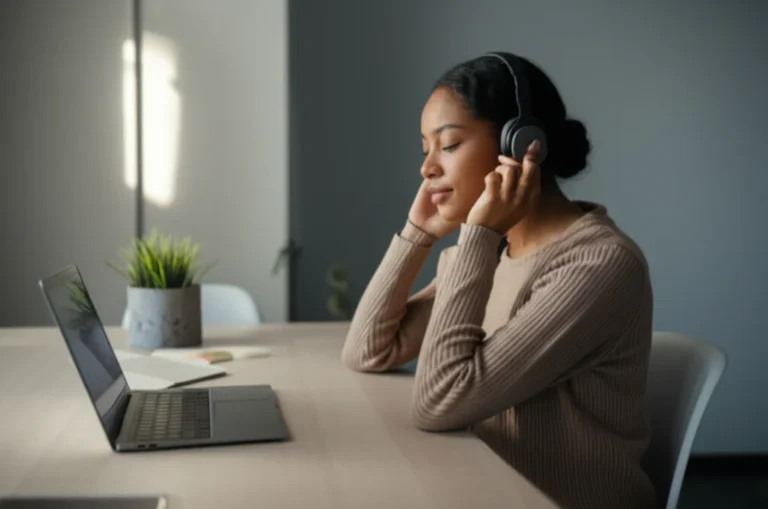
- Put on your headphones.
- Close your eyes.
- Listen to the music without trying to analyze it. Just notice the sounds, the rhythm, the melody.
- Focus on your breath. Inhale for 4 counts, exhale for 4 counts.
- When your mind wanders, gently bring it back to the music and your breath.
The Benefits
- Reduced Anxiety: Lowers cortisol levels.
- Improved Focus: Trains your brain to stay on task.
- Enhanced Creativity: Allows your mind to wander in a controlled way.
The “Flow” State
This technique helps you enter the Flow State faster. By combining the entrainment of music with the calm of mindfulness, you create the perfect environment for deep work.
🔗 Try our Meditation and Music sessions for guided experiences.
🤔 Troubleshooting: When Music Becomes a Distraction
Sometimes, despite your best efforts, music just doesn’t work. Here’s how to troubleshoot.
Problem: I can’t focus at all.
- Solution: Try silence or white noise. Maybe your brain needs a break from sound.
- Alternative: Switch to a different genre. If classical isn’t working, try Lo-Fi or ambient.
Problem: I feel sleepy.
- Solution: Increase the tempo or volume slightly. Switch to a more upbeat instrumental track.
- Alternative: Take a break. Maybe you’re just tired.
Problem: I get distracted by the lyrics.
- Solution: Switch to instrumental music immediately.
- Alternative: Try foreign language music you don’t understand.
Problem: The music is too loud.
- Solution: Lower the volume to 50–65 dB.
- Alternative: Use noise-cancelling headphones to block out external noise so you can keep the music low.
Remember: There is no “one size fits all.” Experiment with different genres, volumes, and timings to find what works for you.
🔗 Need more help? Check out our Mental Health and Relaxation resources.
🏆 Conclusion

So, we’ve journeyed from the assembly lines of Isfahan to the inner workings of your brainwaves. We’ve debunked the Mozart myth, explored the power of binaural beats, and learned why lyrics are the enemy of your to-do list.
The Big Reveal:
The secret to using relaxation music for cognitive performance isn’t about finding the “perfect” song. It’s about matching the music to your task and your state of mind.
- Need to memorize? Go Baroque.
- Need to code? Try Lo-Fi or Binaural Beats.
- Need to relax? Nature sounds are your friend.
- Need to create? Ambient soundscapes will spark your imagination.
Final Recommendation:
Start small. Pick one genre, set your volume to 60 dB, and try it for 25 minutes. Notice how you feel. Adjust from there. Your brain is unique, and so is your perfect soundscape.
And remember, as the study on assembly workers showed, music isn’t just a nice-to-have; it’s a performance enhancer. So, put on those headphones, hit play, and let the music do the heavy lifting.
🔗 Recommended Links
👉 Shop Focus-Boosting Headphones:
- Sony WH-10XM5: Amazon | Best Buy | Sony Official
- Bose QuietComfort 45: Amazon | Bose Official
👉 Shop White Noise Machines:
- LectroFan: Amazon | EurekaMakers
- Homedics SoundSleep: Amazon | Homedics Official
Books on Music and the Brain:
Playlists & Apps:
- Brain.fm: Official Website
- Endel: Official Website
- Spotify Focus Playlists: Spotify
❓ FAQ

Are there specific instruments that boost cognitive performance through music?
Yes, instruments that produce smooth, sustained tones without sharp attacks are generally better. Piano, strings (violin, cello), and flute are excellent choices. Avoid instruments with sudden, jarring sounds or heavy percussion, as these can trigger a startle response and break focus.
Read more about “🎵 7 Ways Relaxation Music Boosts Your Heart Rate Variability (2026)”
Does relaxing music reduce stress and improve mental clarity?
Absolutely. Relaxing music lowers cortisol levels and slows the heart rate, which reduces the “fight or flight” response. This physiological calm allows the prefrontal cortex (the part of the brain responsible for decision-making and focus) to function more efficiently, leading to improved mental clarity.
Read more about “Does Relaxation Music Really Boost Focus and Concentration? 🎧 (2026)”
How long should I listen to relaxation music for cognitive benefits?
For pre-work priming, 15–20 minutes is ideal. During deep work sessions, 45–90 minutes is recommended, followed by a break. If you listen for too long without a break, your brain may habituate to the sound, reducing its effectiveness.
Read more about “🌙 7 Life-Changing Sleep Music Benefits You Need Tonight (2026)”
What is the best music genre for studying and focus?
Baroque Classical (60 BPM) is widely considered the best for memory retention and mathematical tasks. Lo-Fi Hip Hop is excellent for sustained attention and reading. Ambient and Nature Sounds are great for creative tasks and stress reduction.
Read more about “🎧 Does Relaxation Music Boost Focus? 7 Proven Ways (2026)”
Can relaxing music enhance memory and concentration?
Yes. Studies, including the one on assembly workers, show that background music can improve working memory and sustained attention. The mechanism involves reducing stress and increasing dopamine, which enhances cognitive function.
Read more about “8 New Search Terms for Endless Relaxation Music (2026) 🎧”
How does relaxation music affect brain function?
Relaxing music influences brainwave activity, often shifting the brain from high-frequency Beta waves (stress) to Alpha waves (relaxed focus). It also modulates the autonomic nervous system, lowering heart rate and blood pressure, which creates an optimal environment for cognitive tasks.
Read more about “🧠 How Relaxation Music Rewires Your Brain (2026)”
What types of relaxation music improve cognitive performance?
Instrumental music is key. This includes Classical, Ambient, Lo-Fi, and Nature Sounds. Avoid music with lyrics if you are performing language-based tasks, as this causes cognitive overload.
What is the best relaxation music for studying and focus?
Baroque Classical (e.g., Bach, Vivaldi) is the top choice for studying. For focus, Binaural Beats in the Alpha range (8–12 Hz) are highly effective. Lo-Fi is a great alternative for a more modern vibe.
Read more about “🎵 Music Can Reduce Stress: The Science-Backed Essay (2026)”
Does listening to calming music improve cognitive performance?
Yes, but it depends on the task and the individual. For repetitive tasks and memory-based tasks, calming music significantly improves performance. For complex problem-solving, the effect may vary based on personal preference.
How long should I listen to relaxation music to boost brain function?
A 20-minute session before a task can prime your brain. During the task, listen for 45–90 minutes before taking a break. Consistency is key; regular use can help train your brain to enter a focused state more quickly.
Read more about “🎧 7 Proven Relaxing Music Styles for Laser Focus (2026)”
What type of relaxation music is best for deep work sessions?
Instrumental Classical, Ambient Electronic, and Binaural Beats are best for deep work. These genres provide a consistent, non-distracting background that supports sustained attention without overwhelming the brain.
Read more about “🎧 15 Best Relaxation Music Tracks for PTSD Therapy (2026)”
Can relaxation music help reduce stress while solving complex problems?
Yes. By lowering cortisol and heart rate, relaxation music creates a calm mental state that is essential for tackling complex problems. It prevents the “tunnel vision” that stress can cause, allowing for more flexible thinking.
Are there specific frequencies in relaxation music that enhance memory?
Yes, Alpha frequencies (8–12 Hz) are associated with relaxed focus and memory retention. Theta frequencies (4–7 Hz) are linked to creativity and deep learning. Binaural beats can be used to target these specific frequencies.
What is the difference between relaxation music and binaural beats for cognition?
Relaxation music (like classical or ambient) provides emotional and rhythmic structure to reduce stress and improve mood. Binaural beats are a specific technique that uses two slightly different frequencies to entrain brainwaves to a specific state (e.g., Alpha for focus). Binaural beats are more targeted, while relaxation music is more holistic.
📚 Reference Links
- PLOS ONE Study: “Background music improves cognitive performance and reduces fatigue in assembly workers” – Read the Study
- National Institute on Aging: “Could ‘musical medicine’ influence healthy aging?” – Read the Article
- Sony Official Website: Sony Headphones
- Bose Official Website: Bose Audio
- Brain.fm: AI-Generated Focus Music
- Endel: Personalized Soundscapes
- LectroFan: White Noise Machines
- Homedics: SoundSleep Machines
- Spotify: Focus Playlists